
Honeywell Air Duct Cleaning in Sedgefield: A Homeowner’s Guide
If you have a Honeywell electronic air cleaner mounted in your return plenum and a technician cleans around it without pulling and washing the collector cells, you’ve paid to clean most of your air pathway while leaving the dirtiest component untouched. Honeywell air quality equipment lives inside your ductwork, and it changes how a proper cleaning has to be done. This guide explains what’s installed in a typical Sedgefield home, what each piece does, and what to ask before you book. If you’d rather have someone who knows the equipment handle it, call (833) 468-5694 for a free estimate.
What Honeywell equipment is likely installed in a Sedgefield home?
Most Sedgefield homes with Honeywell indoor air quality products have one or more of three components: an electronic air cleaner in the return plenum, a UV germicidal light near the cooling coil, and a TrueZONE damper system controlling airflow to different parts of the house. Each one sits inside the air-handling system and affects how cleaning crews should work.
Here’s what each does:
- F300 electronic air cleaner – sits in the return duct ahead of the blower. Charged plates and collector cells grab fine particulate that a standard filter misses. It’s the component most often ignored during routine duct cleaning.
- UV100 germicidal light – a lamp mounted near the evaporator coil. It shines UV-C light on the coil and surrounding surfaces to suppress microbial growth where condensation keeps things damp. It does not clean the ducts.
- TrueZONE damper system – motorized dampers inside the duct runs that open and close to direct conditioned air to different zones. The zone control board is the brain that coordinates them, and it’s fragile around moisture and static.
In our experience around Sedgefield, the F300 is the piece homeowners know least about. It’s mounted in the return, it collects a surprising amount of material, and it usually gets treated like part of the ductwork instead of the separate device it is.
Why do Honeywell electronic air cleaner cells need separate cleaning?
Because the collector cells are where the particulate actually lands. A duct run carries dust through it, but the F300’s charged plates capture that dust and hold it. Cleaning the ducts without washing the cells leaves the concentrated contamination right where it started, and can even redistribute it downstream once the system fires back up.
The correct process is a sequence, not a pass with a vacuum:
- Power down the air handler and disconnect power to the air cleaner.
- Remove the prefilter and the collector cells from the cabinet.
- Wash the cells in a solution safe for the aluminum plates. Most manufacturer instructions specify a dishwasher-safe approach or a soaking tub at home.
- Let the cells dry completely before reinstallation. Wet cells short out and can damage the power supply.
- Wipe down the cabinet interior and inspect the ionizing wires for breakage or sag.
- Reinstall and confirm the indicator light cycles correctly.
The cells should be washed every one to three months depending on how much the system runs. The cabinet and the ductwork behind it should be cleaned on the same schedule as a full duct cleaning, so the components stay in step. Combining the two is what keeps the whole pathway clean instead of just the parts you can see.
Does a Honeywell UV light replace duct cleaning?
No. A UV germicidal system suppresses microbial growth on surfaces the light reaches. It does not remove dust, dander, pollen, or settled particulate from the duct liner. Those particles have to be agitated and extracted, which is a mechanical job, not a light job.
Think of the UV lamp as ongoing maintenance and duct cleaning as a periodic deep removal. The lamp helps keep the coil area from growing things; the cleaning removes what’s already there. Skip the cleaning and the light keeps shining on a surface that’s coated in dust anyway, which cuts its effectiveness.
What a proper cleaning should do around a UV system:
- Power down and remove the lamp before cleaning the coil or duct behind it.
- Clean the coil surfaces and the cabinet the lamp is mounted in.
- Inspect the lamp for end-of-life darkening and replace it if it’s near the end of its rated life.
- Reinstall and confirm the lamp is operating before the crew leaves.
For the full picture on what a complete system cleaning covers, see our page on air duct cleaning.
How do TrueZONE dampers affect the cleaning process?
Zone dampers create closed sections inside the ductwork. A crew pulling negative pressure through the system with a Nikro HEPA vacuum needs every damper open to reach the full run. If the dampers are left in their default positions, some branches get cleaned and some don’t, and the homeowner has no way to tell the difference once the crew packs up.
Handling zone systems correctly takes a few extra steps:
- 1
Disconnect power to the zone control board before the cleaning begins. Static and moisture both damage it, and it’s not a cheap part to replace.
- 2
Manually open each damper or use the zone controller to drive them all open.
- 3
Clean each zone individually, confirming airflow and vacuum pull through that branch.
- 4
Inspect damper blades for dust buildup and wipe them clean while they’re accessible.
- 5
Restore power and test each zone before leaving.
A crew that doesn’t know TrueZONE equipment exists will either leave the board powered or force a damper by hand. Neither ends well. Asking about zone systems up front saves the phone call after.
What should you ask a duct cleaning contractor if you have Honeywell equipment?
Ask three direct questions before booking. The answers tell you whether the crew is set up for your system or just for a generic duct run. A Sedgefield homeowner with a Honeywell air cleaner deserves a straight answer before anyone shows up.
1. Will you remove, wash, and reinstall my electronic air cleaner cells? If the answer is “we’ll vacuum around it,” keep looking. The cells are the point.
2. Are you familiar with Honeywell service protocols for UV and zone systems? A crew that handles these regularly knows to power down the zone board and pull the UV lamp before cleaning. A crew that doesn’t will either learn on your system or skip the step.
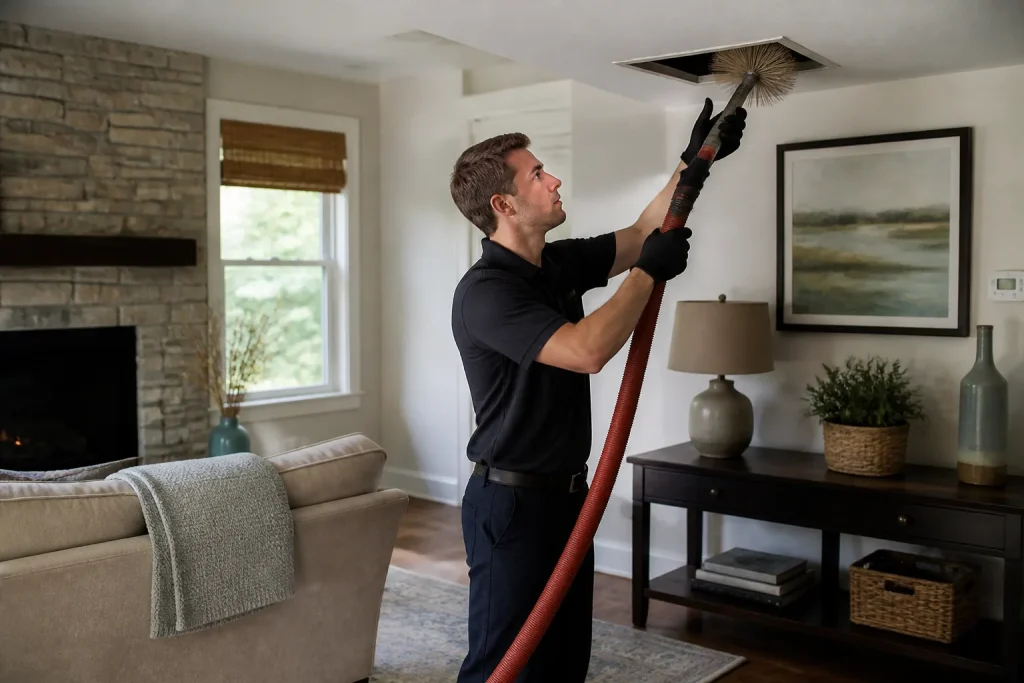
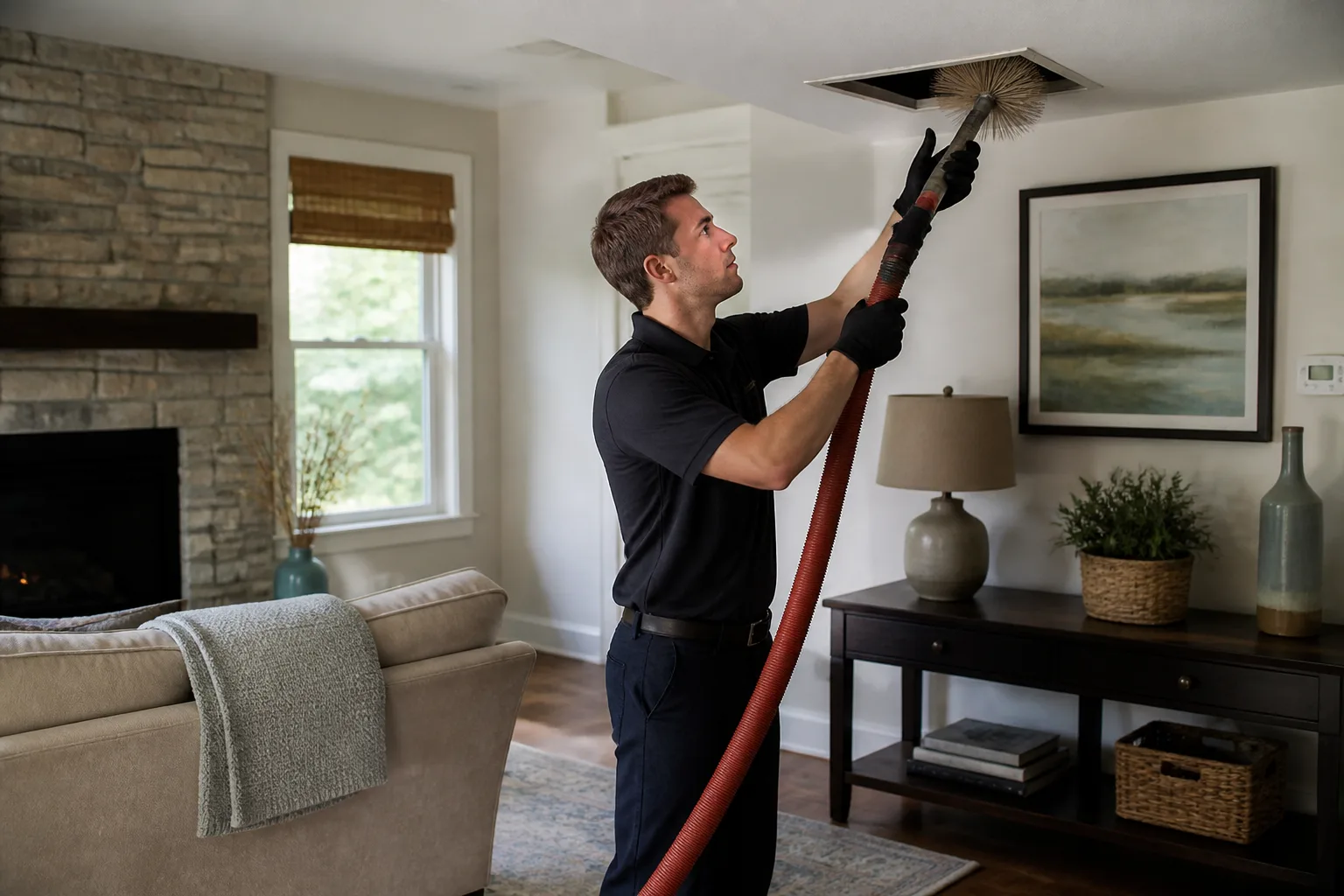
3. What equipment will you bring? Rotary brush agitation paired with HEPA extraction is the standard. We run Rotobrush agitation systems and Nikro HEPA vacuums, which is the combination that pulls particulate out instead of pushing it around the house. Ask what your contractor uses before they arrive.
If the answers are vague, that’s your answer. A proper full-system service includes the components, not just the duct walls. Our HVAC cleaning service covers the air handler and coil, which is where most of the microbial growth sits in a Sedgefield home.
When should you call a pro instead of handling it yourself?
Cleaning the electronic air cleaner cells is genuinely a homeowner task. Pull them, wash them, dry them, put them back. The manufacturer instructions cover it and the cells are designed to come out. But once the job involves the ductwork itself, the air handler interior, the UV lamp housing, or zone dampers, it’s time to call someone with the right equipment.
A few signs it’s time:
- Visible dust blowing out of supply registers right after a filter change.
- A musty smell that returns within days of cleaning the cells.
- Zone dampers that stick or a zone board that’s been acting up.
- Noticeable dust accumulation on the coil or in the return plenum.
If you’re in Sedgefield and any of these sound familiar, a professional cleaning with proper containment and extraction will tell you more in an hour than a month of guessing. Call (833) 468-5694. We answer 24/7. Fast dispatch from 7am to 7pm, Sunday through Friday.
Related services in Sedgefield: if you’re already booking a duct cleaning, it’s worth adding dryer vent cleaning to the same visit. The lint buildup in a dryer vent is the same kind of problem as duct dust, just in a shorter run, and the equipment overlaps.
The Bottom Line
Honeywell air quality equipment is good hardware, but it changes how duct cleaning has to be done. The electronic air cleaner cells need to come out and get washed, the UV system needs to be powered down and pulled before the coil is cleaned, and zone dampers need to be open and the control board disconnected before anyone touches the system. A crew that skips these steps leaves your air pathway half-clean and your expensive components at risk. The right questions before you book are the ones that save you the phone call after.
At Air Duct Cleaning Sedgefield, we clean the full system, ducts, HVAC components, and dryer vents, not just the vents you can see. Rotobrush agitation paired with Nikro HEPA extraction means contaminants come out, not just get pushed around, and we bring Abatement Technologies containment equipment to residential jobs so the dust stays where we put it. Duct sealing after cleaning locks in the results, and our Honeywell and Aprilaire integration lets us recommend and install filtration upgrades on the same visit rather than sending you somewhere else. One flat price per system, agreed before work starts, and before-and-after photos of your own ducts so you know it actually happened.
If you’re in Sedgefield and need help, Air Duct Cleaning Sedgefield offers free estimates. Call (833) 468-5694. We answer 24/7. Fast dispatch from 7am to 7pm, Sunday through Friday.
Frequently Asked Questions
Most homes with a Honeywell electronic air cleaner fall in the $400 to $800 range for a full-system cleaning that includes the collector cells, the duct runs, and the air handler. Homes with multiple zones or a larger footprint can run higher. The written estimate sets the final price, and we give you one flat price per system before any work starts, not per vent. Call (833) 468-5694 for an exact quote; estimates are free.
You can, and it’s better than doing nothing, but it leaves the duct liner untouched. The cells capture what passes through them; dust that settled in the ducts before the cells were installed or during a filter lapse stays put. Cleaning the cells on schedule and the ducts periodically keeps the whole system in step. Call (833) 468-5694 if you’re not sure which you need.
Both make whole-home filtration and humidity control products that install in the same general spot in the duct system. Honeywell is known for electronic air cleaners and zone control; Aprilaire is known for media filters and humidifiers. Which one fits your home depends on what’s already installed and what you’re trying to solve. We work with both and can recommend on-site. Call (833) 468-5694 to talk it through.
Wash the collector cells every one to three months. Clean the full duct system every three to five years for most Sedgefield homes, or sooner if you’ve had a renovation, a filter neglected for a stretch, or visible dust at the registers. Homes with pets or allergy-sensitive occupants tend toward the shorter end. Call (833) 468-5694 and we’ll help you figure out where yours sits.
Written by the team at Air Duct Cleaning Sedgefield.
Need Air Duct Cleaning Help?
Call Air Duct Cleaning Sedgefield - the local pro we connect you with is licensed and insured, here with fast help in Sedgefield.
(833) 468-5694